How to Market Your Trash Can Cleaning Business on Instagram Without Wasting Your Evenings
Ask any trash can cleaning operator how their Instagram is going and you get some version of the same answer. They post a few times a week, they've got a few hundred followers, the odd neighbor mentions they found them on there, and they have absolutely no idea whether any of it is working.
They keep posting because everyone says they should. They feel guilty when a week goes by without anything. They stare at other operators' accounts and wonder how some people seem to be getting dozens of signups from it while they can't buy a new customer off a clip that took them an hour to film and edit.
Here is the honest truth. Most operators are doing Instagram wrong. Not because they're bad at it, but because nobody ever told them what it's actually for in a trash can cleaning business. Once you understand that, the whole thing gets easier, faster, and a lot more profitable.
And here's the part that should make you feel good. Your trade has the single best content on the entire platform handed to it for free. A filthy garbage can, crawling with grime and reeking in the heat, blasted spotless with hot water in thirty seconds. That before-and-after is the most satisfying thing on Instagram. You are sitting on a goldmine. Most operators just point it at the wrong target.
Instagram is not your audience. It's your front door.
The first mental mistake almost every operator makes is thinking about Instagram as a platform they need to grow on. Followers become the scoreboard. Likes become the feedback. Reach becomes the goal. A clip that did a thousand views feels like a win. A clip that did forty feels like failure.
That scoreboard is a distraction. You're not trying to build an audience. You're trying to build a route.
The customers you want live within a few miles of where your truck already runs. Your total addressable market is maybe a few hundred households in the right zip codes on the right trash days. You do not need a hundred thousand followers. You need forty of the right ones, and the rest of your content is there to catch the small handful of new neighbors who are actively thinking about signing up right now.
Once you stop chasing reach and start thinking about Instagram as the front door to your business, what you post changes, how often you post changes, and how much time you give it changes. Everything gets a lot more honest.
The three posts that actually bring in customers
Most operators post a random mix of whatever they can film that week. The truck on Monday. A motivational quote on Wednesday. A logo graphic on Saturday. None of it connects to anything. None of it asks the viewer to do anything. So none of it converts.
There are really only three kinds of Instagram content that pull in new customers for a trash can cleaning business. Everything else is a nice to have.
The first is the before-and-after. This is your unfair advantage, so lean on it hard. A can caked in maggots and dried gunk, then thirty seconds later steaming clean and bright. The hot-water wash mid-blast. The dirty water getting reclaimed into the tank. People will watch a grimy can become spotless on a loop, and that is exactly the customer you want, the one whose own can looks like the "before." Filmed on your phone at the curb, barely edited, beats a slick graphic every single time.
The second is proof that other neighbors trust you. A short thank you text a customer sent you, screenshotted and posted with permission. A clip of a whole street's worth of cans you cleaned on the same trash day, with a caption that mentions half the block is now on a plan. A quick word from a homeowner who's relieved their can no longer reeks in the summer. You do not need testimonial videos or a formal reviews page. You just need to show that real people on real streets are already here and already happy. Social proof is the single most undervalued piece of content in a trash can cleaning business.
The third is behind the scenes. Who you are, how you think about the work, why you do it. The operator filling the tank before dawn. A short piece on why you reclaim the wastewater instead of letting it hit the storm drain. A quick word on what a properly cleaned can should actually look like. People sign up with an operator, not a logo. The more they feel like they know you as a person, the easier the decision becomes.
If you only ever post those three kinds of things, and nothing else, your conversion rate goes up significantly. Most operators post maybe a third of their content inside these three buckets, which is why most trash can cleaning accounts look busy and deliver almost nothing.
Stop posting to people who are never going to book you
This one is going to sound blunt. A huge amount of what operators post on Instagram is aimed at other operators, not at customers.
Equipment rundowns with spec commentary. Photos of a new $40,000 wrapped rig posted for the gearheads. Long captions about pump pressure and nozzle choice that only another operator would care about. Reposts from the big franchise accounts with a heart emoji. This is what the algorithm rewards because other operators are the ones liking and commenting, but none of those operators are going to pay you to clean their cans. You are producing content for an audience that is never going to convert.
Customers care about completely different things. They care about whether their can will stop smelling. Whether their driveway stays clean. Whether you show up on the right day. Whether it's worth the money. Whether they can sign up without a hassle. That is it. If a clip is not answering one of those questions, you are talking to the wrong people.
A useful test before you post anything is to ask whether a homeowner who has never thought about getting their cans cleaned would watch it and feel more inclined to message you. If the answer is no, you are making content for your peers, not your market. That is fine once in a while, but it should not be the bulk of the page.
Your link in bio is either a conversion machine or a conversion killer
Here is the part of Instagram marketing most operators get most wrong, and it is the one part where the fix takes ten minutes and doubles the output of everything else.
When a neighbor finally decides they want their cans cleaned, they do not remember your name. They remember a clip. They open Instagram. They find your profile. They tap the link in your bio. And that tap decides the whole thing.
If the link goes to your homepage with six tabs across the top, they have to work out where to go. If it goes to a Linktree full of different options, they have to pick. If it goes to a DM form, they have to write something and wait for you to reply. Every extra click loses a percentage of the people who tapped. A homeowner who loved the before-and-after thirty seconds ago is already distracted by something else, and you have given them four decisions to make before they reach a checkout.
The link in your bio should do one thing. Take a customer directly to a page where they can see your plans, pick one, and pay. Nothing else. No menus, no forms, no information pages. A booking page, and only a booking page.
This is exactly why a proper branded booking portal matters more than operators think. BookNimble gives you a clean URL you can drop straight into your bio, where customers land on your monthly and quarterly plans, your prices, your branding, and can sign up and pay in a couple of taps. Automatic recurring payments through Stripe, reminders sent before each clean so they leave the can out, and a dashboard showing exactly who is due and who has paid. No back and forth, no typing, no waiting for you to check your phone. Ten minutes to set up, no monthly fee, and you only pay when you get paid. You set the portal up once, and from that point on every clip you post is pointing at a machine that actually converts.
Most operators who switch from a DM-based signup flow to a proper link in bio see the same number of inquiries turn into twice as many signups. The Instagram content was already working. It was just pouring people into a leaky bucket.
Stories do more work than feed posts, and cost you less
Operators put most of their Instagram effort into feed posts. They spend an hour filming and editing, write a long caption, pick a thumbnail, agonize over the timing. Then they post a story that afternoon and almost never bother with stories after that.
The ratio should be the other way around. Stories are where the real work happens in a trash can cleaning business.
Your feed is a shop window. A customer checks it once when they're deciding whether you're a real operation. They scroll down, they get the vibe, they move on. They are almost never checking it twice.
Your stories are a daily broadcast to the people who already follow you. Those are mostly your current customers, your former customers, and local people who are somewhere on the path to signing up. That group needs to see you consistently. Not in perfectly edited feed posts, but in small, casual, in-the-moment snaps. A nasty can getting blasted clean. A sunny morning on the route. A quick shout out to the street you're cleaning today. A reminder that you've got two spots left on this week's run.
An operator who posts one good feed clip a week plus three or four short stories most days will pull in meaningfully more signups than an operator who posts three feed clips a week and nothing in stories. Same amount of work, probably less. Very different outcome.
Local beats viral, every single time
Every so often an operator gets a clip that pops off. A million views. A flood of followers. A buzz in the DMs. And then, three months later, nothing. The signups did not follow because the people who watched were mostly not in your area.
A clip that gets fifty views, forty of which are local homeowners, is worth more to your route than a clip that gets fifty thousand views in a different state. Reach is a vanity number. Local reach is the only number that matters.
This is why tagging your neighborhood and city in every post actually moves the needle. Why using your zip code and local hashtags sparingly but consistently works. Why geotagging the street you cleaned that day, replying to comments from anyone who looks local, and ignoring the ones who are clearly a bot or an operator three states away, matters. The algorithm will slowly learn that your content is most relevant to people in your area, and it will start pushing it to the right people. Local reach is also exactly how you build route density, the thing this whole business lives or dies on. Twenty signups on one street beats twenty scattered across the city every time.
If you are spending time trying to make clips that will go viral, stop. You are optimizing for the wrong thing. Make clips that a local homeowner would save and show their partner tonight. That is the goal.
One hour a week is all you actually need
The final thing operators get wrong is the amount of time they give Instagram. Either they drown in it, spending five or six hours a week and burning out, or they feel so overwhelmed by the expectation that they do almost nothing, which creates guilt and still produces no results.
A good Instagram for a trash can cleaning business runs on about an hour a week, in two blocks.
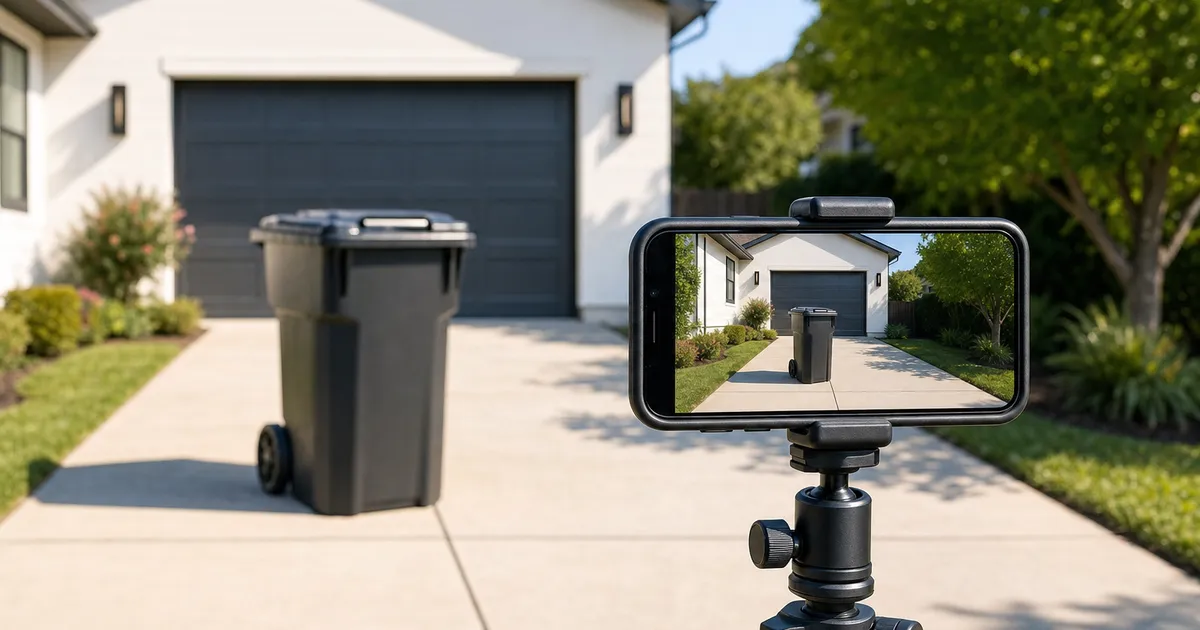
Thirty minutes on your busiest route day to film while you work. You are already there, the cans are filthy, the hot water is running, the before-and-after is happening right in front of you. Clip the best three or four cans on your phone as you clean. Do not try to be a videographer. Just capture the stuff that looks and feels satisfying.
Thirty minutes later in the week to edit lightly, post two or three of them, and write a story or two while you are drinking a coffee. That is it.
If you can keep it to that, Instagram becomes a tool that helps you grow the route, not a side job that drains your week. The operators who sustain good content for years are not the ones who work hardest on it. They are the ones who built a rhythm small enough that they can actually keep it.
Don't forget that Instagram is a means, not an end
Here is the thing nobody says out loud about social media and this trade. The best trash can cleaning businesses in any town are almost never the ones with the biggest Instagram followings. They are the ones with the densest routes, the happiest customers, the cleanest signup experience, and the best word of mouth.
Instagram helps. It catches the new homeowner who has just decided their cans are disgusting and something has to change. It reassures the neighbor who saw your truck on the street and wanted to check you were real. It quietly reminds the customer who is about to cancel that the work still looks great. All of those things matter.
None of them matter more than the cleaning itself, the experience around it, and the simplicity of actually getting signed up. If those three things are right, a basic Instagram account with honest before-and-after content will do most of the heavy lifting for you. If those three things are wrong, the best Instagram account in the world will not save you.
Put the real work into the route and the systems. Use Instagram to tell local homeowners, in a relaxed and honest way, that you turn disgusting cans spotless and you'll do it on a schedule so they never have to think about it again.
The bottom line
Instagram is not a full time job, and it is not a popularity contest. It is a front door for your trash can cleaning business, aimed at a small group of local homeowners who are deciding whether to finally do something about the cans rotting in their garage.
Post the before-and-after, because nobody else on the platform has content this satisfying. Post proof that other neighbors trust you, and a little bit of who you are. Stop making content for other operators. Put a link in your bio that actually lets a customer sign up in two taps. Use stories more than you think, feed posts less than you think, and tag your neighborhood every time. Film during your busiest route, edit lightly, and keep the whole thing inside an hour a week.
Do that for six months and you will not have the biggest cleaning account in your city. You will have something much more useful. A quiet, steady stream of the right homeowners tapping through to your booking page and starting a plan without you ever having to chase a DM.
That is the whole point.
Ready to grow your cleaning business?
Take signups, recurring payments, and reminders in one place with BookNimble.
Related Posts

How to Price Your Trash Can Cleaning Service Without Leaving Money on the Table
Most operators set their first price too low and stay on it for years. Here's how to price a trash can cleaning service so the route runs profitable from day one.

How to Run a Year-End Customer Appreciation Push That Locks In Renewals
A simple year-end thank-you is the cheapest retention you'll ever run. Here's how to use it to lock in plan renewals for next year on your trash can route.